(For Part I, see http://engineeringdecisionmaking.blogspot.com/2015/05/decision-making-and-panama-canal-part-i.html)
After the United States gained control of the Panama Canal effort in 1904, the type of canal was not yet specified. The two alternatives were a sea-level canal and a lock canal.
First, President Theodore Roosevelt appointed thirteen civil engineers to the International Board of Consulting Engineers and told them that the two most important attributes were the speed of construction and the likelihood of successful completion. After conducting their research, eight members voted for a sea-level canal, and five voted for a lock canal. The chairman of Isthmian Canal Commission (ICC), which ran the Canal Zone, and the chief engineer, recommended a lock canal and gave sound technical and financial reasons for their disinterested choice. Eventually, the Senate approved a lock canal. The House of Representatives then concurred, and the president confirmed the choice on June 29, 1906.
To coordinate their experienced personnel, appropriate equipment, and the ingenious system for moving material, the Americans had a centralized organization with authority over every aspect of and employee in the Canal Zone. There were no contractors working in Panama. The headquarters made a detailed plan every day for coordinating the drilling, blasting, excavating, and dumping operations to maximize productivity. Moreover, the motivated employees felt that they were part of a community, which improved morale and productivity.
The canal was officially opened on August 15, 1914. The American decision-making process was a more effective
analytic-deliberative process that was focused on clear objectives (not personal ambition), and
their decision-making system in Panama was more appropriate than the
French scheme.
Wednesday, May 27, 2015

Tuesday, May 19, 2015
Decision Making and the Panama Canal (Part I: the French)
The Panama Canal, which opened in 1914, is one of the most outstanding engineering successes in history. The history of the Panama Canal has many stories of heroic explorers, brilliant engineers, and tireless laborers. It also includes critical choices by rational, intelligent decision-makers. Unfortunately, the French decision-making processes and decision-making system contributed to their failure.
An early critical choice was whether to build a sea-level canal or a lock canal. Ferdinand de Lesseps was a French diplomat who led the effort to build the Suez Canal and became part of a group interested in building a canal across Panama. In 1879 he organized a meeting in Paris to evaluate the options for a canal across Central America. De Lesseps was determined that the sea-level route across Panama should be approved, however, and he personally convinced many French delegates to support that alternative, which helped him and his business associates raise money to build the canal.
Approximately 100 small subcontractors worked to dig the canal, but, without central coordination, they impeded each other’s efforts to remove the excavated dirt and rock. Moreover, the contractors chose the simplest (cheapest) way to dump the excavated dirt and rock, and these operations were often stopped by storms, which slowed the excavation of the canal. They were not loyal to the canal company or motivated by its goals, and there was no central office to coordinate their activities.
The French effort was bankrupt within 10 years.
For more about the canal's history, check out The Canal Builders by Julie Greene and The Path Between the Seas by David McCullough.
Next time: the Americans.
An early critical choice was whether to build a sea-level canal or a lock canal. Ferdinand de Lesseps was a French diplomat who led the effort to build the Suez Canal and became part of a group interested in building a canal across Panama. In 1879 he organized a meeting in Paris to evaluate the options for a canal across Central America. De Lesseps was determined that the sea-level route across Panama should be approved, however, and he personally convinced many French delegates to support that alternative, which helped him and his business associates raise money to build the canal.
Approximately 100 small subcontractors worked to dig the canal, but, without central coordination, they impeded each other’s efforts to remove the excavated dirt and rock. Moreover, the contractors chose the simplest (cheapest) way to dump the excavated dirt and rock, and these operations were often stopped by storms, which slowed the excavation of the canal. They were not loyal to the canal company or motivated by its goals, and there was no central office to coordinate their activities.
The French effort was bankrupt within 10 years.
For more about the canal's history, check out The Canal Builders by Julie Greene and The Path Between the Seas by David McCullough.
Next time: the Americans.
Thursday, May 14, 2015
Columbia's Final Mission
In my Engineering Decision Making and Risk Management class last week we discussed the space shuttle Columbia accident using the case study Columbia's Final Mission by Michael Roberto et al. (http://www.hbs.edu/faculty/Pages/item.aspx?num=32441).
The case study highlights topics related to making decisions in the presence of ambiguous threats, including the nature of the response, organizational culture, and accountability.
It also discusses the results of the Columbia Accident Investigation Board (http://www.nasa.gov/columbia/home/CAIB_Vol1.html).
When discussing the case in class, a key activity is re-enacting a critical Mission Management Team (MMT) meeting, which gives students a chance to identify opportunities to improve decision making.
My class also discussed the design of warning systems, risk management, risk communication, different decision-making processes, and problems in decision making, all of which reinforced the material in the textbook (http://www.isr.umd.edu/~jwh2/textbook/index.html).
We concluded that the structure of the MMT made effective risk communication difficult and key NASA engineers and managers failed to describe the risk to those in charge.
Moreover, the decision-makers used a decision-making process that prematurely accepted a claim that the foam strike would cause only a turn-around problem, not a safety-of-flight issue, and this belief created another barrier to those who were concerned about the safety of the astronauts and wanted more information.
Failures such as the Columbia accident are opportunities to learn, and case studies are a useful way to record and transmit information about failures, which is essential to learning.
We learned how ineffective risk communication and poor decision-making processes can lead to disaster.
The case study highlights topics related to making decisions in the presence of ambiguous threats, including the nature of the response, organizational culture, and accountability.
It also discusses the results of the Columbia Accident Investigation Board (http://www.nasa.gov/columbia/home/CAIB_Vol1.html).
When discussing the case in class, a key activity is re-enacting a critical Mission Management Team (MMT) meeting, which gives students a chance to identify opportunities to improve decision making.
My class also discussed the design of warning systems, risk management, risk communication, different decision-making processes, and problems in decision making, all of which reinforced the material in the textbook (http://www.isr.umd.edu/~jwh2/textbook/index.html).
We concluded that the structure of the MMT made effective risk communication difficult and key NASA engineers and managers failed to describe the risk to those in charge.
Moreover, the decision-makers used a decision-making process that prematurely accepted a claim that the foam strike would cause only a turn-around problem, not a safety-of-flight issue, and this belief created another barrier to those who were concerned about the safety of the astronauts and wanted more information.
Failures such as the Columbia accident are opportunities to learn, and case studies are a useful way to record and transmit information about failures, which is essential to learning.
We learned how ineffective risk communication and poor decision-making processes can lead to disaster.
Monday, May 4, 2015
Nepal's Earthquake Risk
The recent earthquake in Nepal, one of the poorest countries in the
world, is a horrible disaster. The potential for injuries, death, and
destruction were well-known. Coincidentally, last week, a student in my
engineering decision making and risk management course submitted an
assignment summarizing a 2000 report on this topic written by experts
from Nepal and California.
The report is Amod M. Dixit, Laura R. Dwelley-Samant, Mahesh Nakarmi, Shiva B. Pradhanang, and Brian E. Tucker. "The Kathmandu Valley earthquake risk management project: an evaluation." Asia Disaster Preparedness Centre, 2000.
It can be found at http://www.iitk.ac.in/nicee/wcee/article/0788.pdf.
The report stated that "a devastating earthquake is inevitable in the long term and likely in the near future." Indeed, the report cited data that earthquakes with magnitude of more than 8 on the Richter scale occur in that region approximately every 81 years. The Nepal-Bihar earthquake (magnitude 8.2) was in 1934 (81 years ago).
The report described various factors that increase the earthquake risk in Nepal, including the high probability of liquefaction due to local soil conditions, poorly constructed dwellings that are more likely to fail and "a tendency in the general population to ignore the earthquake hazard due to more immediate needs."
The project described by the report emphasized awareness-raising as part of creating institutions that would work to reduce the earthquake risk. Increasing awareness depended upon sharing information about the earthquake risk, including estimates about the potential loss of life. The authors reported that this risk communication "did not create any panic in the population. It rather made a larger part of the society wanting to improve the situation. This leads us to believe that the traditional belief of possible generation of panic should not be used as an excuse for not releasing information on risk."
In addition to the report, additional information about the Kathmandu Valley Earthquake Risk Management project can be found online at
http://geohaz.org/projects/kathmandu.html.
The report is Amod M. Dixit, Laura R. Dwelley-Samant, Mahesh Nakarmi, Shiva B. Pradhanang, and Brian E. Tucker. "The Kathmandu Valley earthquake risk management project: an evaluation." Asia Disaster Preparedness Centre, 2000.
It can be found at http://www.iitk.ac.in/nicee/wcee/article/0788.pdf.
The report stated that "a devastating earthquake is inevitable in the long term and likely in the near future." Indeed, the report cited data that earthquakes with magnitude of more than 8 on the Richter scale occur in that region approximately every 81 years. The Nepal-Bihar earthquake (magnitude 8.2) was in 1934 (81 years ago).
The report described various factors that increase the earthquake risk in Nepal, including the high probability of liquefaction due to local soil conditions, poorly constructed dwellings that are more likely to fail and "a tendency in the general population to ignore the earthquake hazard due to more immediate needs."
The project described by the report emphasized awareness-raising as part of creating institutions that would work to reduce the earthquake risk. Increasing awareness depended upon sharing information about the earthquake risk, including estimates about the potential loss of life. The authors reported that this risk communication "did not create any panic in the population. It rather made a larger part of the society wanting to improve the situation. This leads us to believe that the traditional belief of possible generation of panic should not be used as an excuse for not releasing information on risk."
In addition to the report, additional information about the Kathmandu Valley Earthquake Risk Management project can be found online at
http://geohaz.org/projects/kathmandu.html.
Tuesday, March 31, 2015
California's offshore oil and gas platforms
An article by Max Henrion in the February 2015 issue of OR/MS Today described the decision analysis used to determine the best option for decommissioning 27 offshore oil and gas platforms off the coast of Southern California. A complete report on the analysis can be found here.
The article illustrates two of the three critical perspectives on decision making: (1) the problem-solving perspective (what do with the platforms) and (2) the decision-making process perspective (how to make the decision).
From the problem-solving perspective, the decision is actually 27 decisions, one for each platform. The article lists multiple options in three categories: complete removal, partial removal, and leave in place for reuse. Within each category were multiple alternatives.
The attributes used to evaluate the alternatives were costs, air quality, water quality, impacts on marine mammals, impacts on birds, impacts on the benthic zone, fish production, ocean access, and compliance with lease terms.
Based on the stakeholders' preferences, the analysts created a multi-attribute model. For each platform, each decommissioning alternative was given a score (on a 0 to 100 scale) for each attribute, and the scores were combined using a weighted sum. The alternative with the best total score was identified as the best for that platform.
From the decision-making process perspective, the process was an analytic-deliberative one, and the analysis involved many traditional tools, including influence diagrams, decision trees, sensitivity analysis, and swing weighting.
A multidisciplinary analysis team began by identifying a wide range of options but determined that some were technically or legally infeasible. They then evaluated the remaining ones in more detail.
This included creating quantitative models to determine how decommissioning would affect fish production and ocean access. They constructed a computer program that lets a user update the scores and weights. They conducted sensitivity analysis to determine how uncertainties in costs and the impact of changing the weights on the attributes. The most influential factor was the weight on compliance; a higher weight on compliance increased the desirability of complete removal.
After completing its analysis, the team then issued its report to its client and released its model to the stakeholders. The deliberative part of the process included a series of meetings with stakeholders and the public and policy discussions that led to legislation that enables partial removal, the alternative that reduces both environmental impacts and costs.
I recommend the article as a case study of the analytic-deliberative process and an illustration of how decision analysis tools can be used.
The article illustrates two of the three critical perspectives on decision making: (1) the problem-solving perspective (what do with the platforms) and (2) the decision-making process perspective (how to make the decision).
From the problem-solving perspective, the decision is actually 27 decisions, one for each platform. The article lists multiple options in three categories: complete removal, partial removal, and leave in place for reuse. Within each category were multiple alternatives.
The attributes used to evaluate the alternatives were costs, air quality, water quality, impacts on marine mammals, impacts on birds, impacts on the benthic zone, fish production, ocean access, and compliance with lease terms.
Based on the stakeholders' preferences, the analysts created a multi-attribute model. For each platform, each decommissioning alternative was given a score (on a 0 to 100 scale) for each attribute, and the scores were combined using a weighted sum. The alternative with the best total score was identified as the best for that platform.
From the decision-making process perspective, the process was an analytic-deliberative one, and the analysis involved many traditional tools, including influence diagrams, decision trees, sensitivity analysis, and swing weighting.
A multidisciplinary analysis team began by identifying a wide range of options but determined that some were technically or legally infeasible. They then evaluated the remaining ones in more detail.
This included creating quantitative models to determine how decommissioning would affect fish production and ocean access. They constructed a computer program that lets a user update the scores and weights. They conducted sensitivity analysis to determine how uncertainties in costs and the impact of changing the weights on the attributes. The most influential factor was the weight on compliance; a higher weight on compliance increased the desirability of complete removal.
After completing its analysis, the team then issued its report to its client and released its model to the stakeholders. The deliberative part of the process included a series of meetings with stakeholders and the public and policy discussions that led to legislation that enables partial removal, the alternative that reduces both environmental impacts and costs.
I recommend the article as a case study of the analytic-deliberative process and an illustration of how decision analysis tools can be used.
Thursday, March 5, 2015
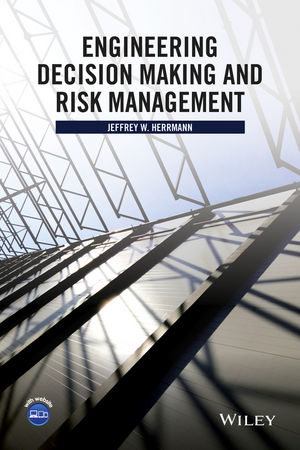
Hardcover version available in April.
Saturday, February 21, 2015
Mitigating the risks from small UAVs
Earlier this week, the FAA released proposed rules for operators of small UAVs (drones). Small UAVs are those that weigh less than 55 pounds.
From a risk management perspective, the rules propose a variety of preventive actions: fly only in daylight, do not fly over people, do not fly in bad weather, fly below 500 feet altitude, fly at speeds less than 100 miles per hour, and do not fly in airport flight paths and restricted airspace areas. Most of the rules are meant to prevent accidents by reducing the likelihood of losing control, colliding with other aircraft, and crashing into third persons on the ground.
The rules do not propose any contingency plans to minimize risk when the operator loses control of the UAV. Indeed, perhaps the only ones that can be considered are fanciful ones like a "disassemble" command that makes the UAV divide into smaller pieces that would cause less damage on impact or deploying airbags like those on the Mars Pathfinder. A more reasonable contingency might be a siren and flashing light that are activated to warn those nearby when the UAV begins to crash (like shouting "fore" when a golfer drives a ball towards unsuspecting bystanders).
From a risk management perspective, the rules propose a variety of preventive actions: fly only in daylight, do not fly over people, do not fly in bad weather, fly below 500 feet altitude, fly at speeds less than 100 miles per hour, and do not fly in airport flight paths and restricted airspace areas. Most of the rules are meant to prevent accidents by reducing the likelihood of losing control, colliding with other aircraft, and crashing into third persons on the ground.
The rules do not propose any contingency plans to minimize risk when the operator loses control of the UAV. Indeed, perhaps the only ones that can be considered are fanciful ones like a "disassemble" command that makes the UAV divide into smaller pieces that would cause less damage on impact or deploying airbags like those on the Mars Pathfinder. A more reasonable contingency might be a siren and flashing light that are activated to warn those nearby when the UAV begins to crash (like shouting "fore" when a golfer drives a ball towards unsuspecting bystanders).
Subscribe to:
Posts (Atom)